From “Rain Bombs” to Cloud Data: Climate-Resilient HIV Service Continuity through a Paperless CBO System and Public-Civil Society Partnership in Southern Thailand
30/09/2026
Key-Population-Led Health Providers Increased Access to Same Day-Antiretroviral Therapy (SD-ART): Result from 7 Provinces in Thailand
01/10/2026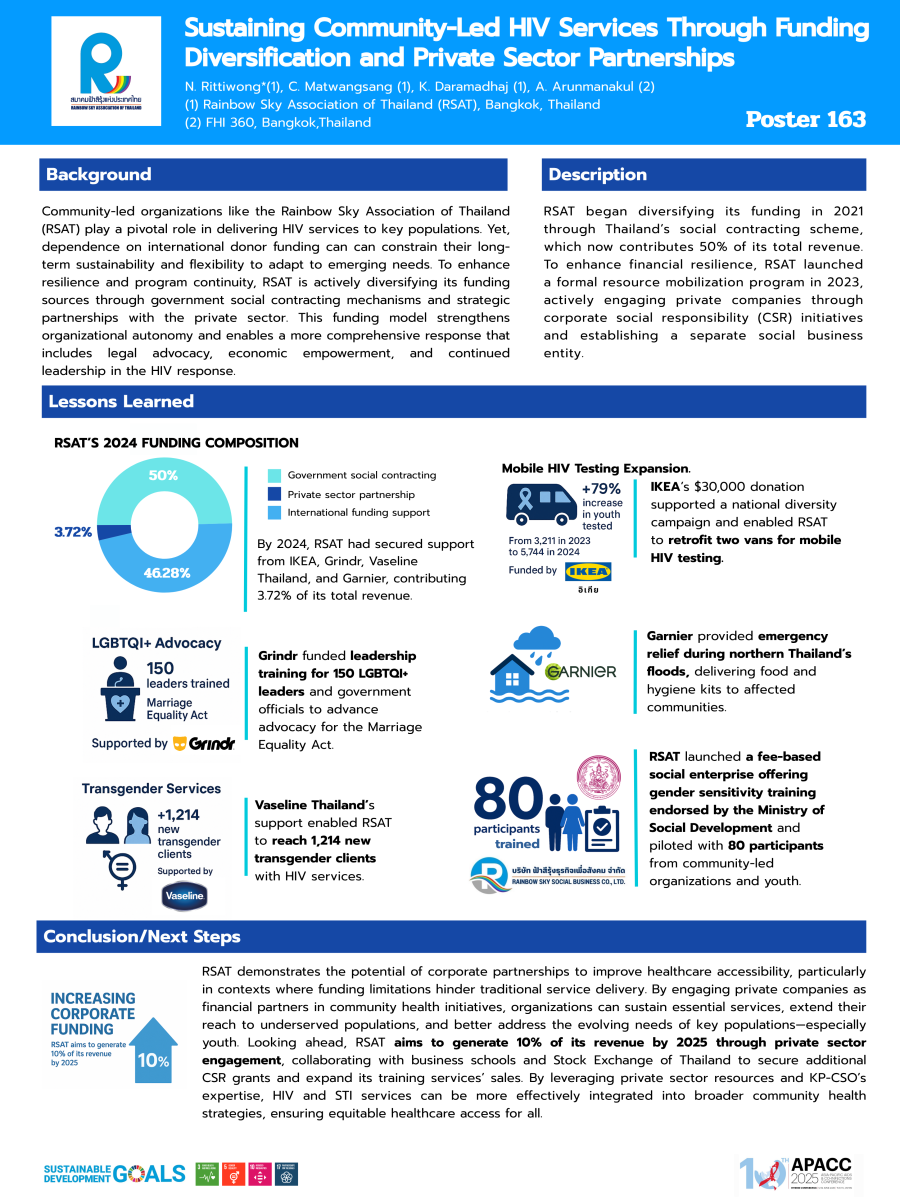
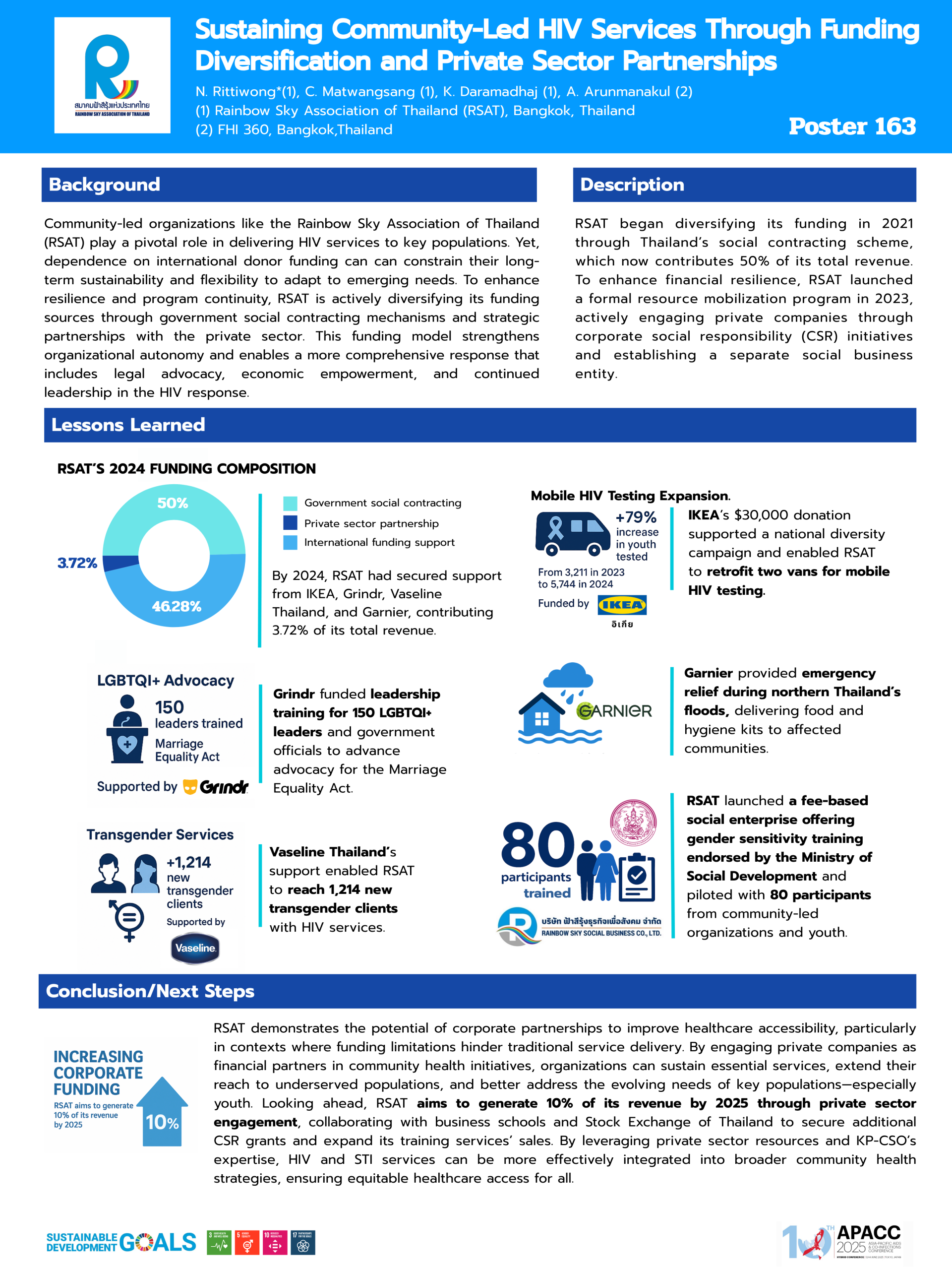
Community-led organizations like the Rainbow Sky Association of Thailand (RSAT) are pivotal in delivering HIV services to key populations. Diversifying funding through social contracting by host governments and private partnerships is crucial for stability, autonomy, and responsiveness.
ประเด็นสำคัญ
- By 2024, RSAT secured support from IKEA, Grindr, Vaseline Thailand, and Garnier, contributing 3.72% of its total revenue.
- Mobile HIV testing increased from 3,211 people tested in 2023 to 5,744 in 2024.
- Vaseline’s contribution expanded services to 1,214 new transgender clients.
- Grindr’s funding supported training for 150 LGBTQI+ leaders and government representatives.
- RSAT aims to generate 10% of its revenue by 2025 through private sector engagement.
Background
Community-led organizations like the Rainbow Sky Association of Thailand (RSAT) are pivotal in delivering HIV services to key populations. However, reliance on international donors can limit their ability to address evolving needs and ensure sustainability. Diversifying funding through social contracting by host governments and private partnerships is crucial for stability, autonomy, and responsiveness. This approach empowers RSAT to address broader needs, including legal advocacy and livelihood support, while maintaining leadership in the global HIV response.
Description
RSAT began diversifying its funding in 2021 through Thailand’s social contracting scheme, which now accounts for 50% of total revenue earned. To enhance financial resilience, RSAT launched a formal resource mobilization program in 2023, actively engaging private companies through corporate social responsibility (CSR) initiatives and to set up a separate social business entity.
Lessons learned
By 2024, RSAT secured support from IKEA, Grindr, Vaseline Thailand, and Garnier, contributing 3.72% of its total revenue. This support enabled RSAT to customize two vans for mobile HIV testing targeting young key populations (YKP) aged 15–24 years, increasing those tested from 3,211 in 2023 to 5,744 in 2024. Vaseline’s contribution expanded services to 1,214 new transgender clients, while Grindr’s funding strengthened advocacy for the Marriage Equality Act by training 150 LGBTQI+ leaders and government representatives. Garnier’s grant provided critical emergency relief during floods in northern Thailand, supporting communities with food and hygiene supplies. Additionally, RSAT successfully registered a company as part of its social business initiative to offer fee-based gender sensitivity training programs endorsed by the Ministry of Social Development and Human Security (MSDHS). These programs support companies in meeting their commitments to the Sustainable Development Goals (SDGs) and were piloted with 80 participants from community-led organizations and YKP, in collaboration with provincial attorney general offices and regional MSDHS offices.
Conclusions/Next steps
RSAT highlights the value of partnerships and diversified funding for resilience and adaptability. Looking ahead, RSAT aims to generate 10% of its revenue by 2025 through private sector engagement, collaborating with business schools and Stock Exchange of Thailand to secure additional CSR grants and expand its training services’ sales.
