“Sai-Sa-Bai-Jai”: From Digital Clicks to Clinical Care – A Successful Hybrid Model for Enhancing PrEP and ART Linkage in Thailand
30/09/2026
Sustaining Community-Led HIV Services Through Funding Diversification and Private Sector Partnerships
01/10/2026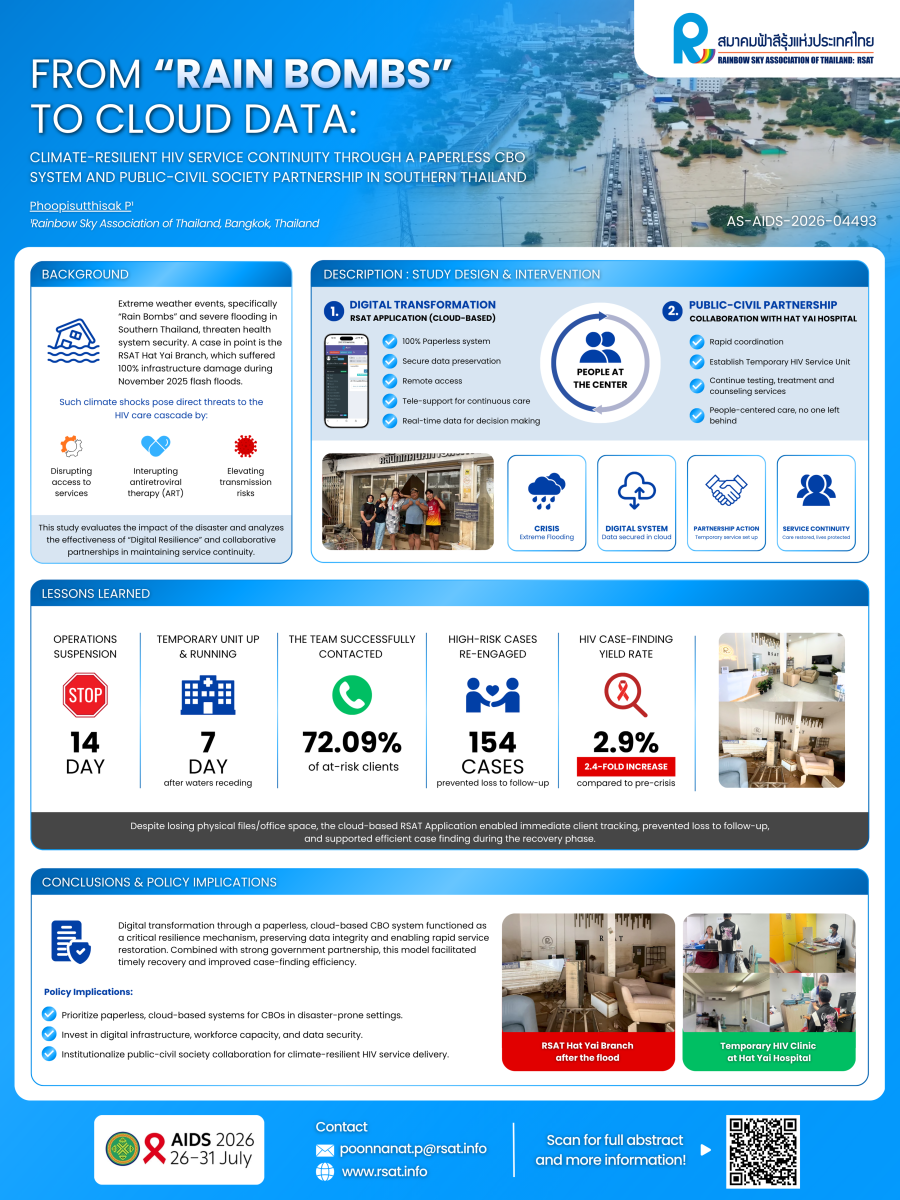
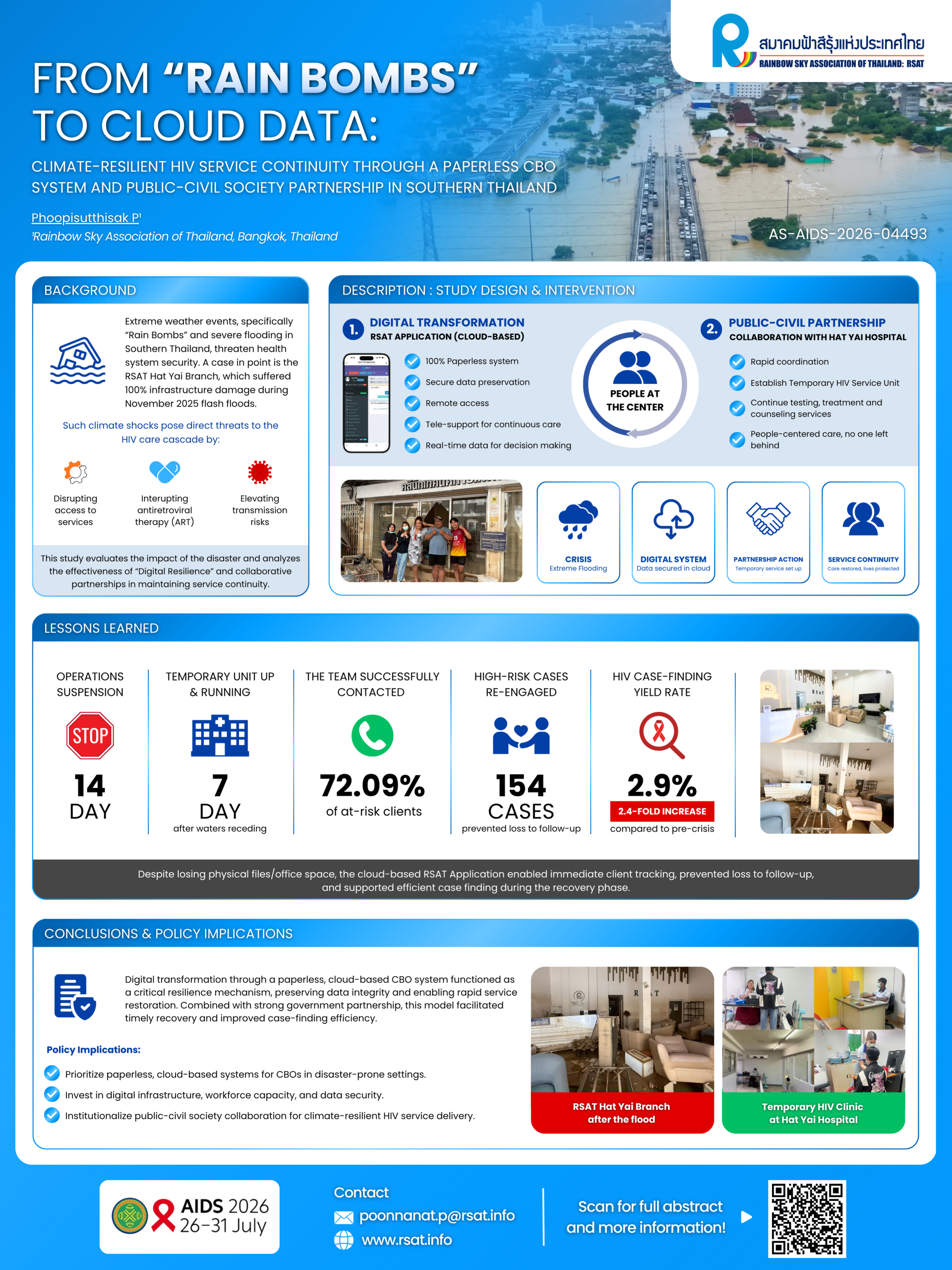
Climate-resilient HIV service continuity through a 100% paperless cloud-based RSAT system and public–civil society partnership after severe flooding in Southern Thailand.
ประเด็นสำคัญ
- 14-day operations suspension
- Temporary HIV service unit operational within 7 days after waters receded
- 72.09% of at-risk clients contacted
- 154 high-risk cases re-engaged
- HIV yield rate 2.9% during recovery, a 2.4-fold increase from pre-crisis
Background
Extreme weather events, specifically “Rain Bombs” and severe flooding in Southern Thailand, threaten health system security. A case in point is the RSAT Hat Yai Branch, which suffered 100% infrastructure damage during November 2025 flash floods. Such climate shocks pose direct threats to the HIV care cascade by disrupting access, interrupting antiretroviral therapy (ART), and elevating transmission risks. This study evaluates the impact of the disaster and analyzes the effectiveness of “Digital Resilience” and collaborative partnerships in maintaining service continuity.
Description
This retrospective operational analysis (October 2025–January 2026) compared pre-crisis, crisis, and recovery phases. It focused on a dual mechanism response: 1) Data Transformation via the RSAT Application, a fully cloud-based, 100% paperless system enabling secure preservation, remote access, and tele-support; and 2) Seamless Partnership with Hat Yai Hospital to establish an emergency temporary HIV service unit. Program data were utilized to assess client tracing, re-engagement, and case-finding outcomes.
Lessons learned
Flooding caused a 14-day operations suspension. However, through public-civil collaboration, a temporary unit became operational within 7 days of waters receding. Crucially, the RSAT Application was the pivotal success factor. Despite losing physical files/office space, the digital database allowed immediate client tracking. Consequently, the team successfully contacted 72.09% of at-risk clients and re-engaged 154 cases at high risk of treatment interruption, preventing loss to follow-up. Furthermore, the system supported efficient case finding during recovery, where the HIV yield rate surged to 2.9% (a 2.4-fold increase pre-crisis).
Conclusions/Next steps
Digital transformation through a paperless, cloud-based CBO system functioned as a critical resilience mechanism, preserving data integrity and enabling rapid service restoration. Combined with strong government partnership, this model facilitated timely recovery and improved case-finding efficiency. Policy implications include prioritizing paperless systems for CBOs in disaster-prone settings and institutionalizing public–civil society collaboration for climate-resilient HIV service delivery.
