
Key-Population-Led Health Providers Increased Access to Same Day-Antiretroviral Therapy (SD-ART): Result from 7 Provinces in Thailand
01/10/2026
Reaching Never-Tested Youth Engaging in Chemsex: Digital Outreach for HIV/STIs Case Finding in Songkhla Province, Thailand
02/10/2026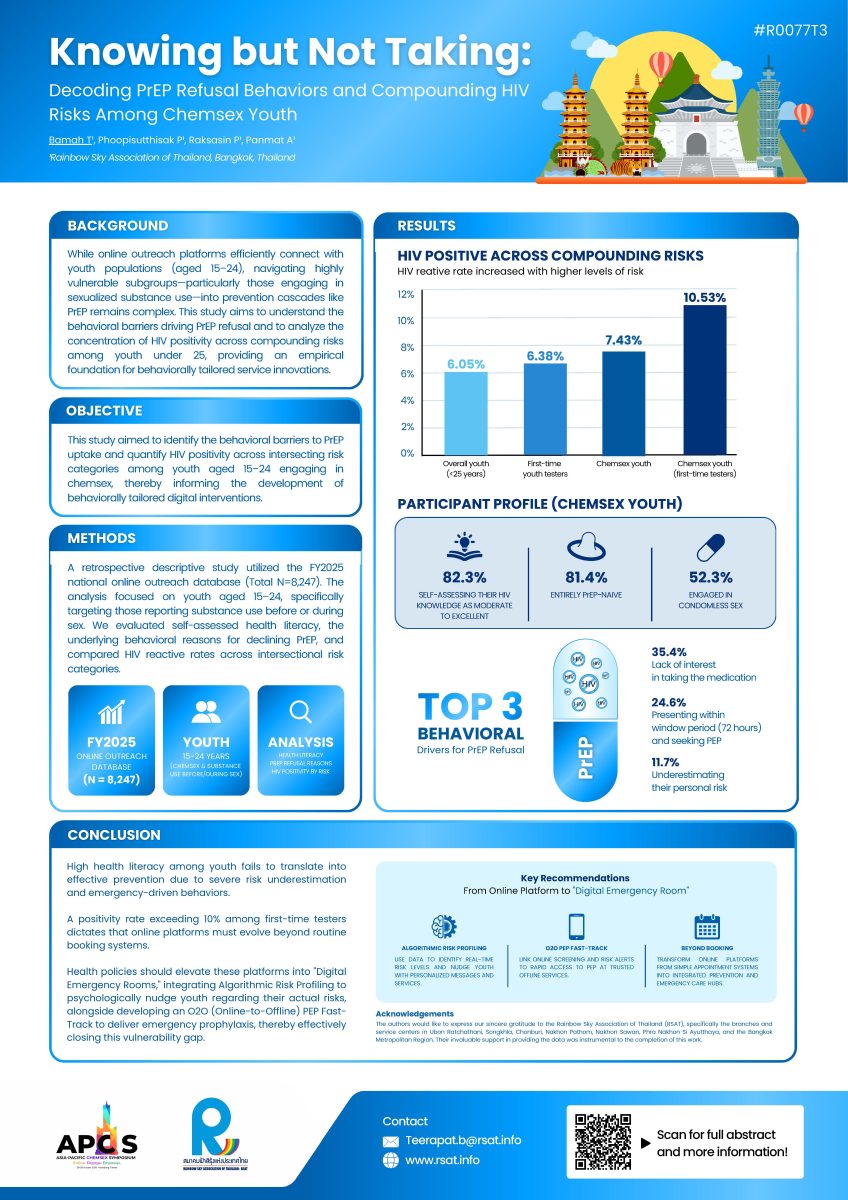
While online outreach platforms efficiently connect with youth populations aged 15–24, navigating highly vulnerable subgroups—particularly those engaging in sexualized substance use—into prevention cascades like PrEP remains complex. This study examines behavioral barriers driving PrEP refusal and HIV positivity across compounding risks among youth under 25.
ประเด็นสำคัญ
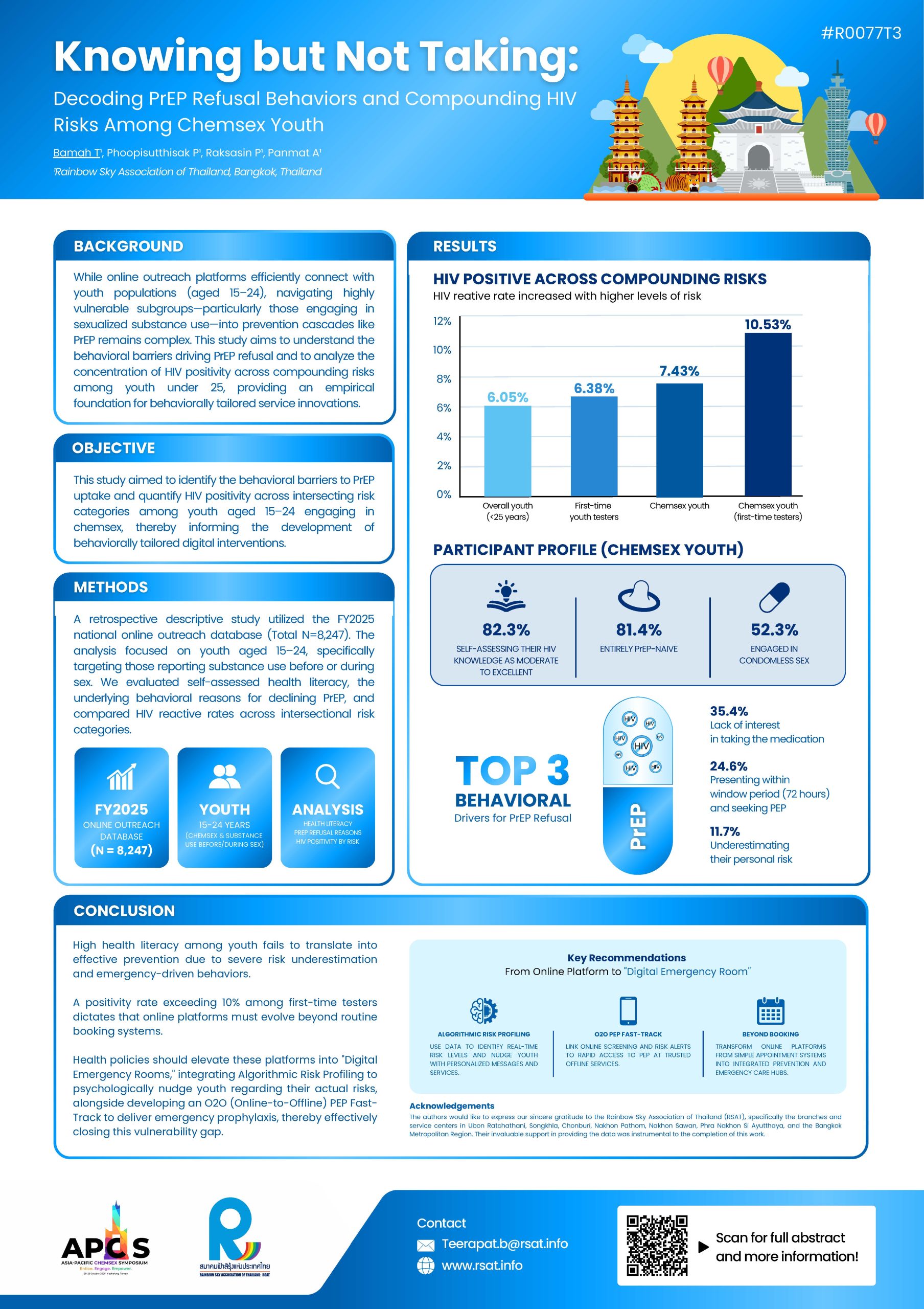
- The baseline HIV reactive rate among youth under 25 was 6.05%.
- Among chemsex youth, 82.3% self-assessed their HIV knowledge as moderate to excellent, 52.3% engaged in condomless sex, and 81.4% were entirely PrEP-naive.
- The top behavioral drivers for PrEP refusal were lack of interest in taking medication (35.4%), presenting within the window period and seeking PEP (24.6%), and underestimating personal risk (11.7%).
- HIV reactive rates were 6.38% among first-time youth testers, 7.43% among chemsex youth, and 10.53% among chemsex youth testing for the first time.
Background
While online outreach platforms efficiently connect with youth populations (aged 15–24), navigating highly vulnerable subgroups—particularly those engaging in sexualized substance use—into prevention cascades like PrEP remains complex. This study aims to understand the behavioral barriers driving PrEP refusal and to analyze the concentration of HIV positivity across compounding risks among youth under 25, providing an empirical foundation for behaviorally tailored service innovations.
Objective
This study aimed to identify the behavioral barriers to PrEP uptake and quantify HIV positivity across intersecting risk categories among youth aged 15–24 engaging in chemsex, thereby informing the development of behaviorally tailored digital interventions.
Methods
A retrospective descriptive study utilized the FY2025 national online outreach database (Total N=8,247). The analysis focused on youth aged 15–24, specifically targeting those reporting substance use before or during sex. We evaluated self-assessed health literacy, the underlying behavioral reasons for declining PrEP, and compared HIV reactive rates across intersectional risk categories.
Results
The baseline HIV reactive rate among the youth cohort (<25 years old) was 6.05%. An in-depth analysis of chemsex youth revealed a distinct “Knowledge-Action Gap.” Despite 82.3% self-assessing their HIV knowledge as moderate to excellent, 52.3% engaged in condomless sex, and 81.4% were entirely PrEP-naive. An analysis of why this group did not receive PrEP revealed three primary behavioral drivers: 1) a lack of interest in taking the medication (35.4%); 2) presenting within the window period (having risk within 72 hours and seeking PEP) (24.6%); and 3) underestimating their personal risk (11.7%). Evaluating compounding risks demonstrated a progressive escalation in HIV positivity: first-time youth testers (6.38%) and chemsex youth (7.43%). Most alarmingly, among chemsex youth testing for the very first time, the reactive rate surged to 10.53%.
Conclusion
High health literacy among youth fails to translate into effective prevention due to severe risk underestimation and emergency-driven behaviors. A positivity rate exceeding 10% among first-time testers dictates that online platforms must evolve beyond routine booking systems. Health policies should elevate these platforms into “Digital Emergency Rooms,” integrating Algorithmic Risk Profiling to psychologically nudge youth regarding their actual risks, alongside developing an O2O (Online-to-Offline) PEP Fast-Track to deliver emergency prophylaxis, thereby effectively closing this vulnerability gap.
