
Reaching Never-Tested Youth Engaging in Chemsex: Digital Outreach for HIV/STIs Case Finding in Songkhla Province, Thailand
02/10/2026
Using Documented HIV Seroconversion Data to Develop Chemsex-Responsive Prevention Services in a Community-Led Clinic in Northeast Thailand
02/10/2026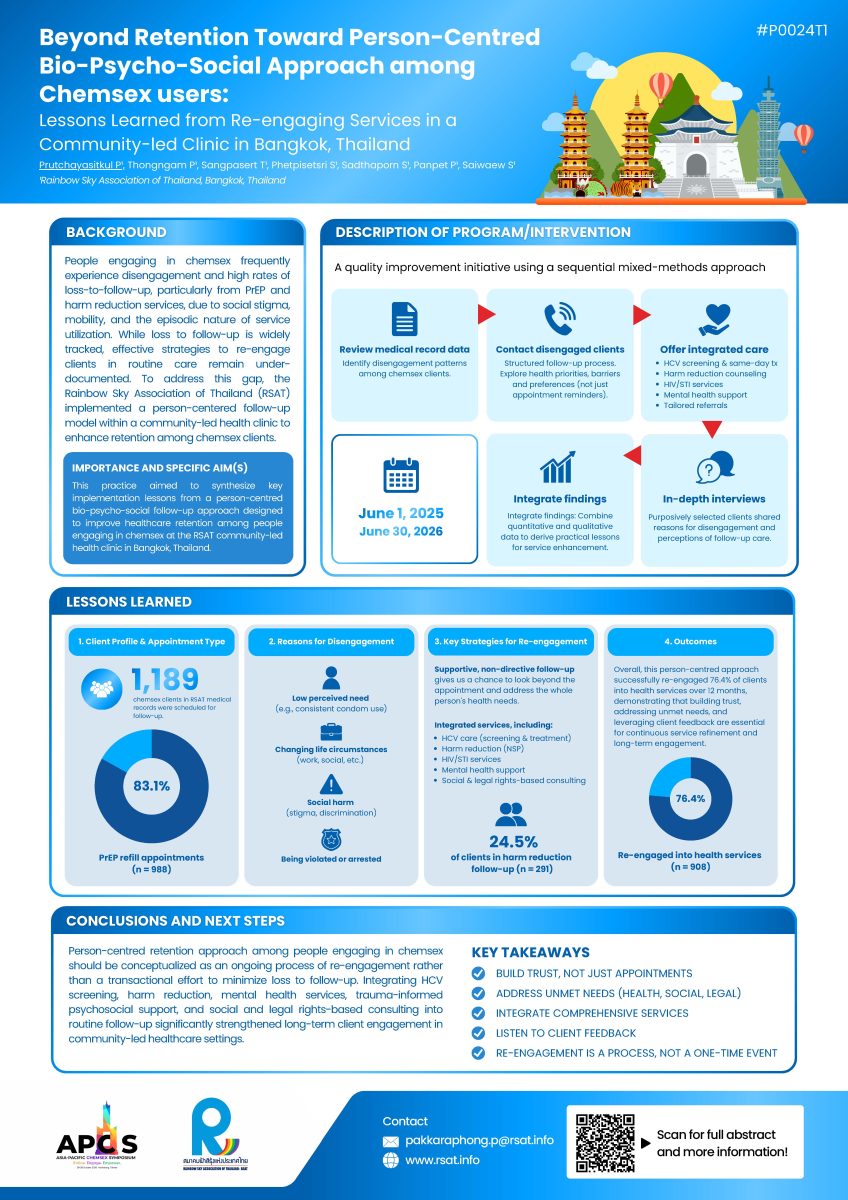
People engaging in chemsex frequently experience disengagement and high rates of loss-to-follow-up, particularly from PrEP and harm reduction services. This work synthesizes implementation lessons from a person-centred bio-psycho-social follow-up approach at an RSAT community-led health clinic in Bangkok.
ประเด็นสำคัญ
- Among 1,189 chemsex clients scheduled for follow-up, 83.1% were PrEP refill appointments (n=988).
- Disengagement was driven by low perceived need, changing life circumstances, social harm, and being violated or arrested.
- 24.5% of clients were in harm reduction follow-up (n=291).
- Over 12 months, the person-centred approach successfully re-engaged 76.4% of clients into health services (n=908).
- Supportive, non-directive follow-up and integrated services were identified as key strategies for long-term engagement.
Background
People engaging in chemsex frequently experience disengagement and high rates of loss-to-follow-up, particularly from PrEP and harm reduction services, due to social stigma, mobility, and the episodic nature of service utilization. While loss to follow-up is widely tracked, effective strategies to re-engage clients in routine care remain under-documented. To address this gap, the Rainbow Sky Association of Thailand (RSAT) implemented a person-centered follow-up model within a community-led health clinic to enhance retention among chemsex clients.
Importance and specific aim(s)
This practice aimed to synthesize key implementation lessons from a person-centred bio-psycho-social follow-up approach designed to improve healthcare retention among people engaging in chemsex at the RSAT community-led health clinic in Bangkok, Thailand.
Description of program/intervention
A quality improvement initiative using a sequential mixed-methods approach reviewed medical record data to identify disengagement patterns among chemsex clients. Disengaged clients were contacted through a structured follow-up process. Rather than solely enforcing scheduled appointments, conversations explored clients’ health priorities, barriers, and preferences. Clients were offered integrated care, including HCV screening and same-day treatment, harm reduction counseling, HIV/STI services, mental health support, and tailored referrals. Purposively selected clients participated in in-depth interviews exploring reasons for disengagement and perceptions of follow-up care. Quantitative and qualitative findings were integrated to derive practical lessons for service enhancement. From June 1, 2025, to June 30, 2026.
Lessons learned
Among 1,189 chemsex clients in RSAT’s medical records were scheduled for follow-up, 83.1% were PrEP refill appointments (n = 988). Clients were contacted to address the reason; disengagement occurred across multiple stages, driven by low perceived need and shifted to consistent condom use, changing life circumstances, in particular competing work, social harm, and being violated or arrested. Community Providers strongly valued supportive, non-directive follow-up, viewing it as an opportunity to address broader health needs rather than a mere appointment reminder. Offering integrated services in alternatives, including HCV care, harm reduction, Needle and Syringes Program, HIV/STI, and trauma-informed psychosocial support, basic social rights-based service, was a key strategy for clients, especially 24.5% of clients in harm reduction follow-up (n = 291). Consequently, over the 12 months, this person-centred approach successfully re-engaged 76.4% of clients into health services (n=908), demonstrating that building trust, addressing unmet needs, and leveraging client feedback are essential for continuous service refinement and long-term engagement.
Conclusions and next steps
Person-centred retention approach among people engaging in chemsex should be conceptualized as an ongoing process of re-engagement rather than a transactional effort to minimize loss to follow-up. Integrating HCV screening, harm reduction, mental health services, trauma-informed psychosocial support, and social and legal rights-based consulting into routine follow-up significantly strengthened long-term client engagement in community-led healthcare settings.
