Using Documented HIV Seroconversion Data to Develop Chemsex-Responsive Prevention Services in a Community-Led Clinic in Northeast Thailand
02/10/2026
Enhancing HIV Care Cascade and Chemsex Interventions: The Programmatic Evidence of Integrated Community-led Harm Reduction Services in Bangkok, Thailand
21/10/2026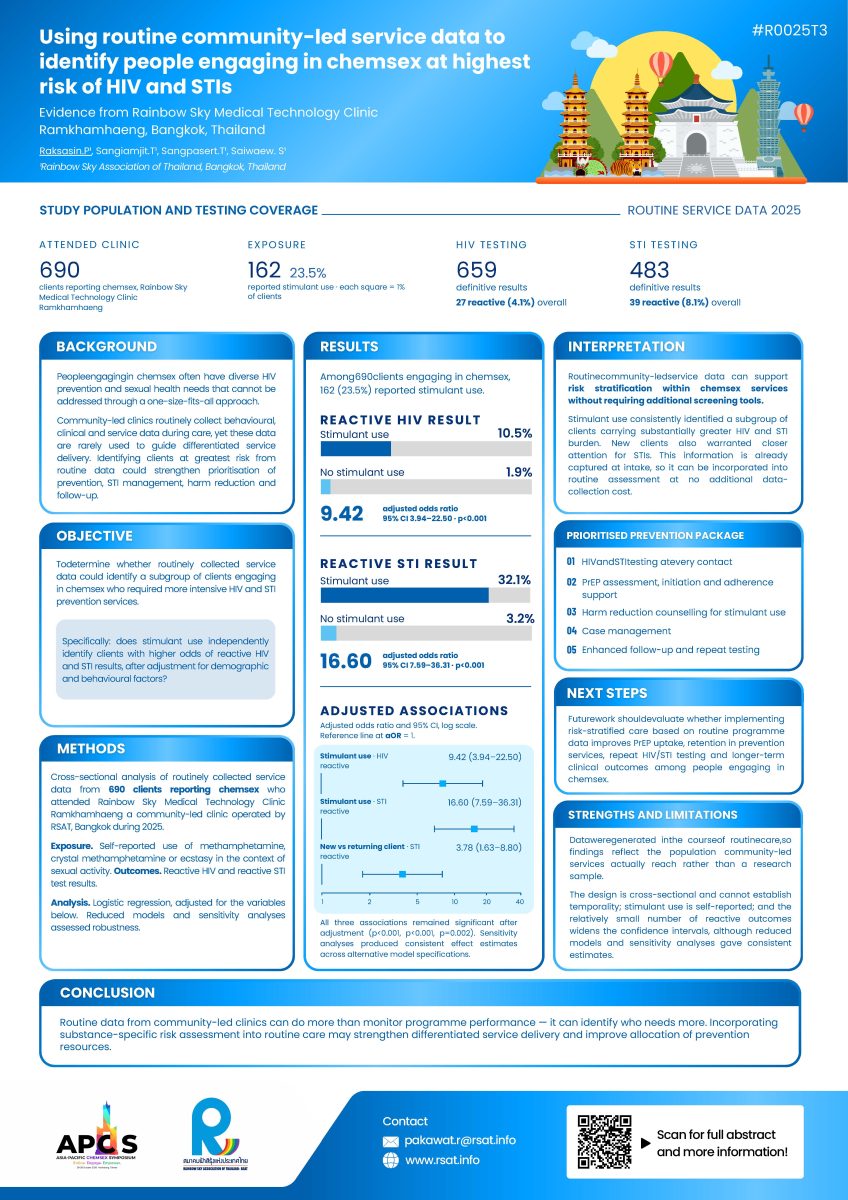
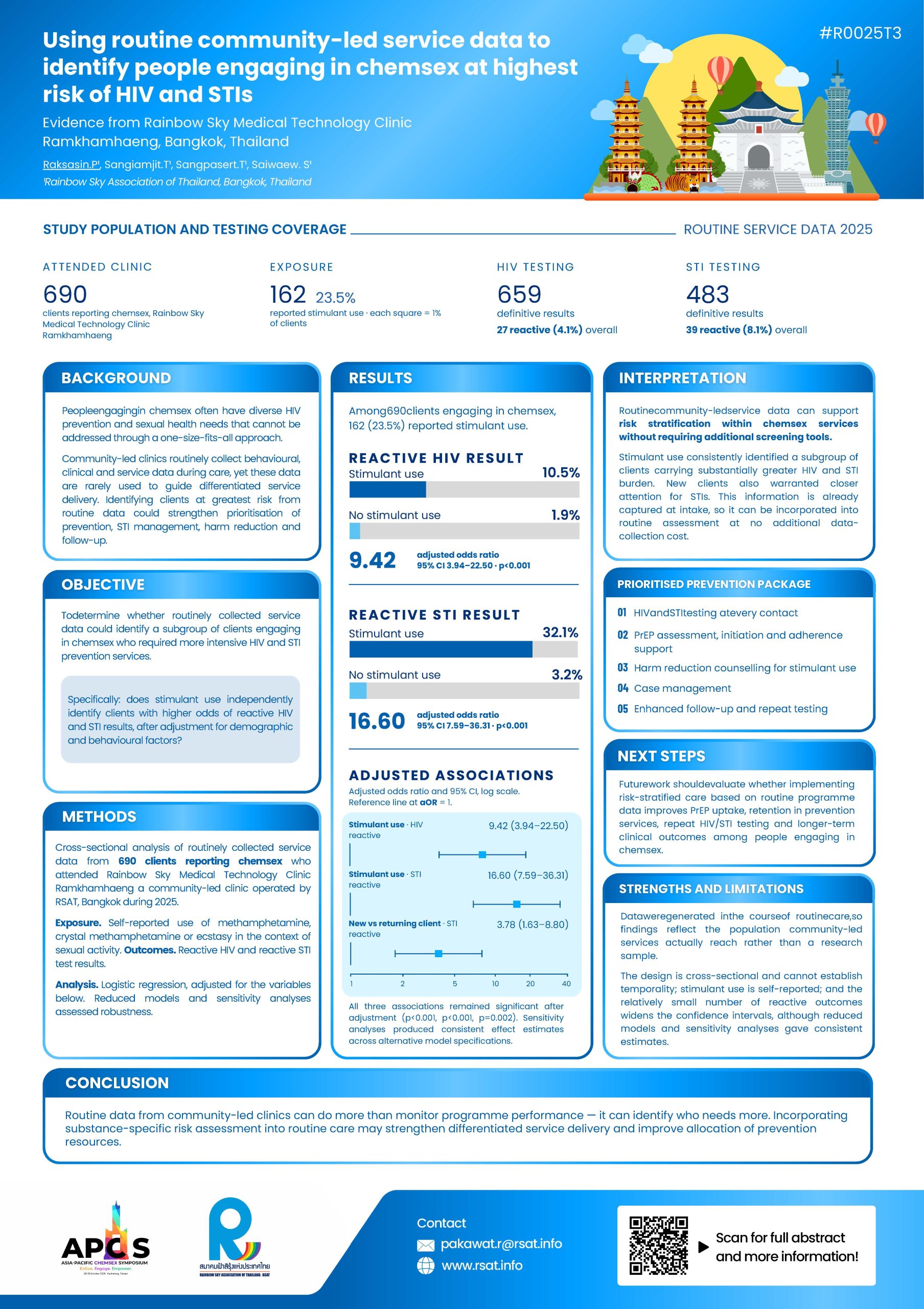
Routine community-led service data from Rainbow Sky Medical Technology Clinic Ramkhamhaeng were used to identify people engaging in chemsex at highest risk of reactive HIV and STI results and to guide differentiated prevention services.
ประเด็นสำคัญ
- Among 690 clients engaging in chemsex, 162 (23.5%) reported stimulant use.
- Among 659 clients with definitive HIV results, 27 (4.1%) had reactive HIV results; HIV reactivity was 10.5% among stimulant users versus 1.9% among non-users.
- Stimulant use was independently associated with HIV reactivity (aOR 9.42; 95% CI 3.94–22.50; p<0.001).
- Among 483 clients with definitive STI results, 39 (8.1%) had reactive STI results; STI positivity was 32.1% among stimulant users versus 3.2% among non-users.
- Stimulant use was independently associated with reactive STI results (aOR 16.60; 95% CI 7.59–36.31; p<0.001), and new clients had higher odds of STI reactivity than returning clients (aOR 3.78; 95% CI 1.63–8.80; p=0.002).
Background
People engaging in chemsex often have diverse HIV prevention and sexual health needs that cannot be addressed through a one-size-fits-all approach. Community-led clinics routinely collect behavioural, clinical, and service data during care, yet these data are rarely used to guide differentiated service delivery. Identifying clients at greatest risk using routinely collected data could strengthen prioritization of HIV prevention, STI management, harm reduction, and follow-up within community-led services.
Importance and Specific Aim
This study aimed to determine whether routinely collected service data could identify a subgroup of clients engaging in chemsex who required more intensive HIV and STI prevention services. Specifically, we examined whether stimulant use independently identified clients with higher odds of reactive HIV and STI test results after adjustment for demographic characteristics and behavioural factors.
Methods
A cross-sectional analysis was conducted using routinely collected service data from 690 clients reporting chemsex who attended Rainbow Sky Medical Technology Clinic Ramkhamhaeng, a community-led clinic operated by the Rainbow Sky Association of Thailand (RSAT), Bangkok, Thailand, during 2025. Stimulant use was defined as self-reported use of methamphetamine, crystal methamphetamine, or ecstasy in the context of sexual activity. Primary outcomes were reactive HIV and STI test results. Associations were evaluated using logistic regression. Multivariable analyses adjusted for age, client status (new versus returning), population group, previous PrEP use, condom use, transactional sex, and nationality. Reduced models and sensitivity analyses were conducted to assess model robustness and minimize overfitting resulting from the relatively small number of reactive outcomes.
Results
Among 690 clients engaging in chemsex, 162 (23.5%) reported stimulant use. Among 659 clients with definitive HIV results, 27 (4.1%) had reactive HIV results. HIV reactivity was substantially higher among stimulant users than non-users (10.5% vs. 1.9%). After adjustment, stimulant use remained independently associated with HIV reactivity (aOR 9.42; 95% CI 3.94–22.50; p<0.001). Among 483 clients with definitive STI results, 39 (8.1%) had reactive STI results. STI positivity was 32.1% among stimulant users compared with 3.2% among non-users. Stimulant use remained independently associated with reactive STI results (aOR 16.60; 95% CI 7.59–36.31; p<0.001). New clients also had significantly higher odds of STI reactivity than returning clients (aOR 3.78; 95% CI 1.63–8.80; p=0.002). Sensitivity analyses produced consistent effect estimates across alternative model specifications, supporting the robustness of the findings.
Interpretation
Routine community-led service data can support risk stratification within chemsex services without requiring additional screening tools. Stimulant use consistently identified a subgroup of clients with substantially greater HIV and STI burden, suggesting that this information can be incorporated into routine assessment to prioritize comprehensive prevention packages, including HIV and STI testing, PrEP assessment, harm reduction counselling, case management, and enhanced follow-up. This approach demonstrates how routinely collected programme data can be translated into practical decision-making to improve service delivery in community-led settings.
Conclusion / Next Steps
Routine data collected by community-led clinics can be used not only for monitoring programme performance but also for identifying clients engaging in chemsex who require more intensive HIV and STI prevention services. Incorporating substance-specific risk assessment into routine community-led care may strengthen differentiated service delivery and improve allocation of prevention resources. Future work should evaluate whether implementing risk-stratified care based on routine programme data improves PrEP uptake, retention in prevention services, repeat HIV/STI testing, and longer-term clinical outcomes among people engaging in chemsex.
