From “Rain Bombs” to Cloud Data: Climate-Resilient HIV Service Continuity through a Paperless CBO System and Public-Civil Society Partnership in Southern Thailand
30/09/2026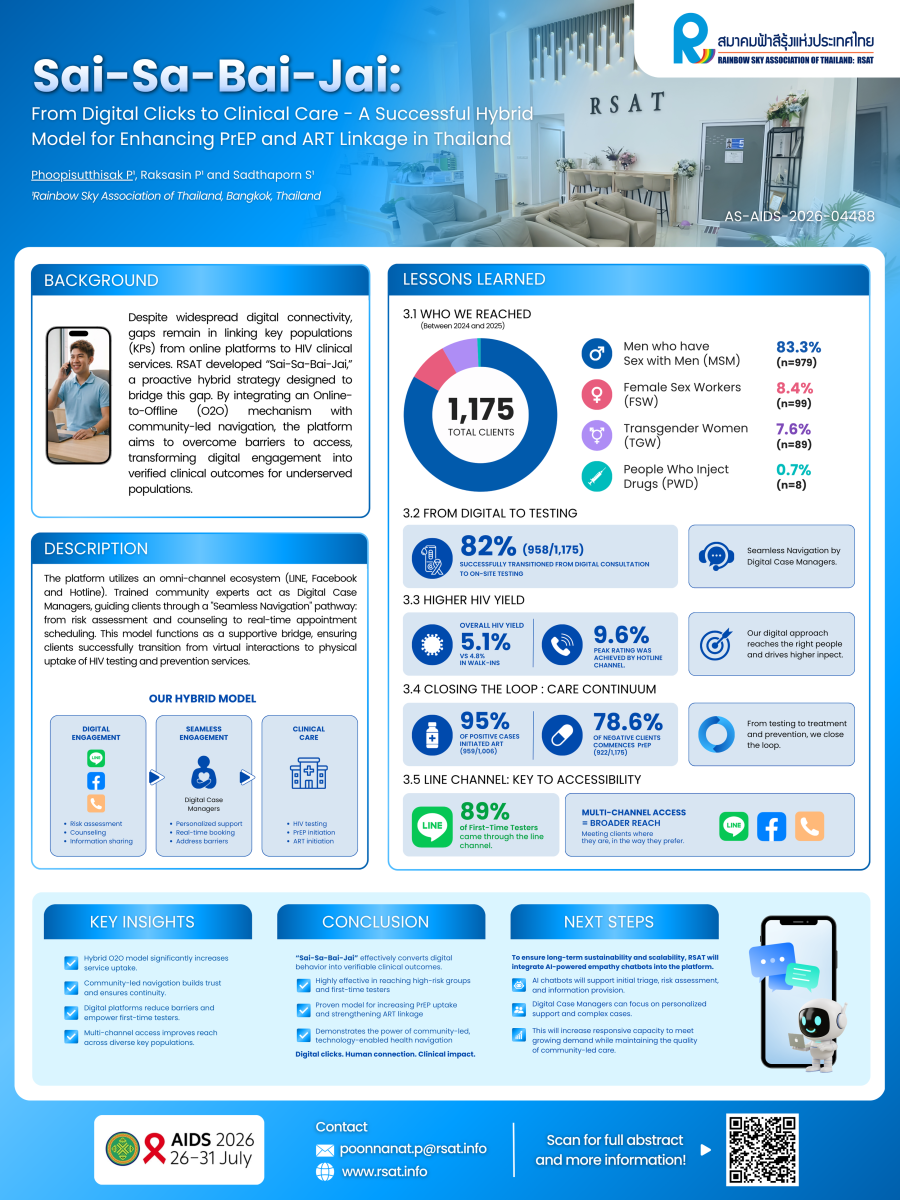
A hybrid Online-to-Offline HIV service model combining LINE, Facebook, Hotline and community-led Digital Case Managers to improve linkage to testing, PrEP and ART.
Background
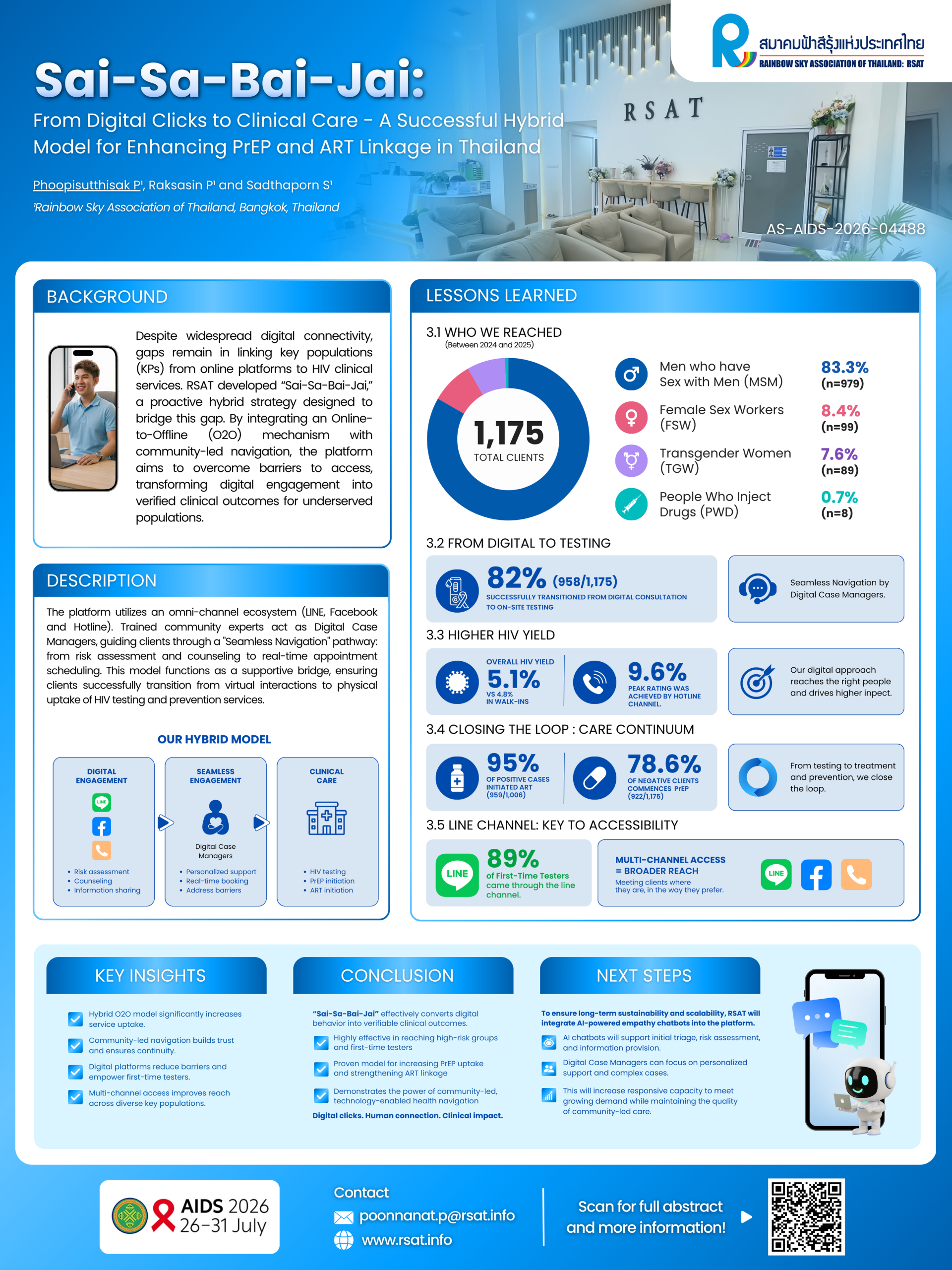
Despite widespread digital connectivity, gaps remain in linking key populations (KPs) from online platforms to HIV clinical services. RSAT developed “Sai-Sa-Bai-Jai,” a proactive hybrid strategy designed to bridge this gap. By integrating an Online-to-Offline (O2O) mechanism with community-led navigation, the platform aims to overcome barriers to access, transforming digital engagement into verified clinical outcomes for underserved populations.
Description
The platform utilizes an omni-channel ecosystem (LINE, Facebook, Hotline). Trained community experts act as Digital Case Managers, guiding clients through a “Seamless Navigation” pathway: from risk assessment and counseling to real-time appointment scheduling. This model functions as a supportive bridge, ensuring clients successfully transition from virtual interactions to physical uptake of HIV testing and prevention services.
Lessons learned
Between 2024 and 2025, the platform engaged 1,175 clients, predominantly Men who have Sex with Men (83.3%, n=979), followed by Female Sex Workers (8.4%, n=99), Transgender Women (7.6%, n=89), and PWID (0.7%, n=8). The model demonstrated exceptional efficacy, with 82% (958/1,175) successfully transitioning from digital consultation to on-site testing. The HIV yield was 5.1% (vs 4.8% in walk-ins), with the Hotline channel achieving a peak of 9.6%. The platform effectively “closed the loop”: 95% of positive cases-initiated ART, and 78.6% of negative clients commenced PrEP. Crucially, the LINE channel was pivotal for accessibility, accounting for 89% of first-time testers.
Conclusions/Next steps
“Sai-Sa-Bai-Jai” effectively converts digital behavior into verifiable clinical outcomes, proving instrumental in reaching high-risk groups and first-time testers. To ensure long-term sustainability and scalability, RSAT plans to integrate AI-powered empathy chatbots. This technology will support Digital Case Managers by handling initial triage, thereby increasing responsive capacity to meet growing demand while maintaining the quality of community-led.
